 |
| This "bike-in cinema" is one of many art installations seeking to redefine the parking spot that you'll find scattered throughout the streets of Mechelen throughout the summer. |

Friday, July 10, 2015
Bike-in cinema
Pic of the week

Saturday, April 11, 2015
The Royal Greenhouses of Laeken
Quirky Belgium

Harmony? Unity? Decadence?
You could argue that a King or a Queen has no place in a democracy, but that would be to miss the point. Today's Kings and Queens, stripped of any real powers, are like hedges: pieces of decoration put on the side to stand there and look pretty.


 |
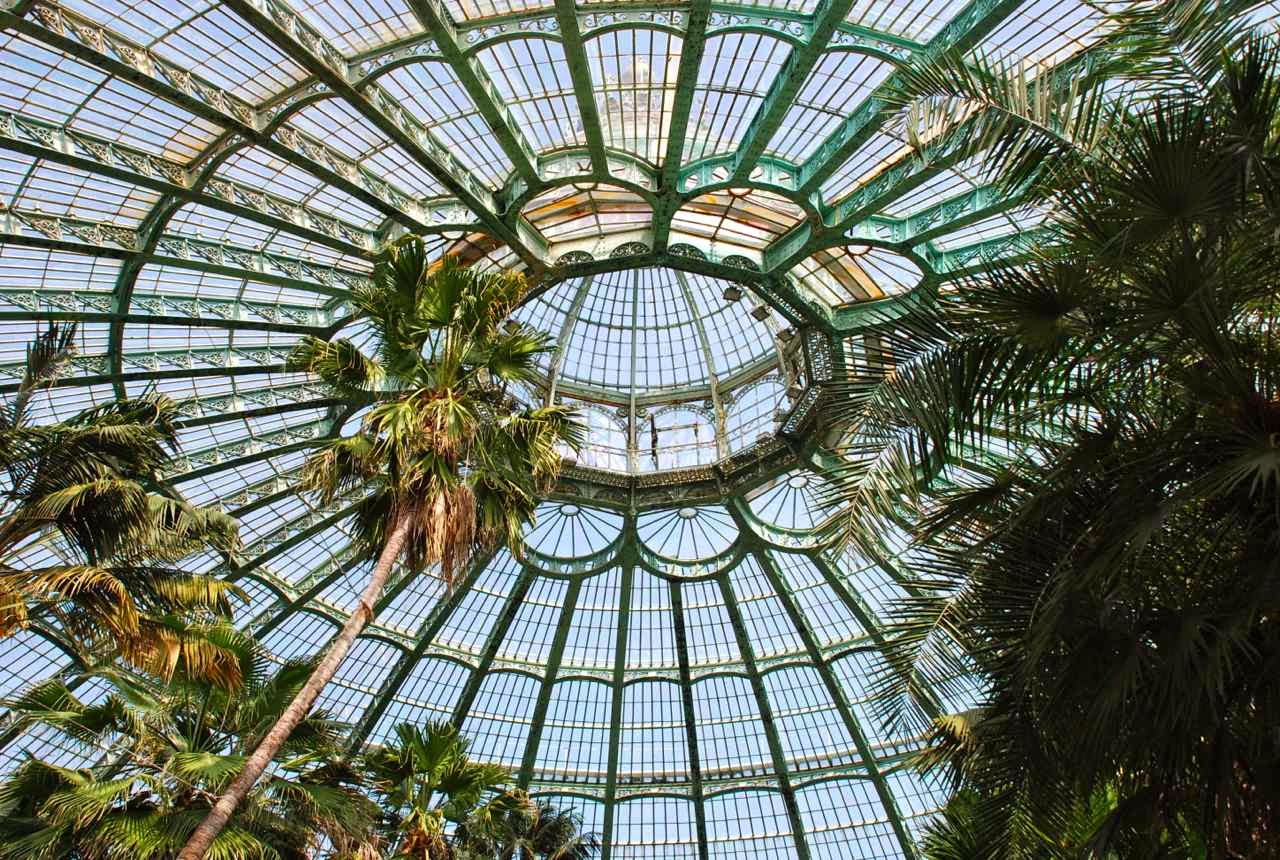
| The Royal Greenhouses of Laeken are open to the public for three weeks this year from April 17 to May 8 |
"It’s good to be the King!" And that’s true for the King of Belgium too whose role nowadays is purely symbolic – although symbolic of what, I’m not sure.
Harmony? Unity? Decadence?
You could argue that a King or a Queen has no place in a democracy, but that would be to miss the point. Today's Kings and Queens, stripped of any real powers, are like hedges: pieces of decoration put on the side to stand there and look pretty.
And no place better captures the hedge-like harmony, unity, and decadence of the Belgian monarchy than the Royal Greenhouses of Laeken, (Dutch: Koninklijke Serres van Laken, French: Serres Royales de Laeken), next to the royal family’s residence on the outskirts of Brussels.
Off limits to the public for most of the year, the Royal Greenhouses open their doors for three weeks each spring to we the people. If you’ve not been, I highly recommend a visit. Not only will you see an amazing collection of exotic flowers and plants, but it's worth going just to see the fantastically bulbous metal and glass buildings designed in the 1870s by Alphonse Balat, mentor to the other great Belgian architect of the Art Nouveau era, Victor Horta.
This year you can check out the Royal Greenhouses starting Friday, April 17 until May 8.
Find out more here.
Saturday, April 4, 2015
Piano man
Pic of the week
 |
| There are a few pianos in St. Pancras Station, London, that anyone can sit down and play at. This young guy was really good and I was glad to catch a few notes before my train left for Brussels on Thursday. |
Monday, March 30, 2015
USA deconstructed
Last weekend my daughter's school had an open house. Everyone was welcome, whether you went to the school or not, and activities were organized around the theme "travel." In different classrooms, parents from various ethnic backgrounds put on workshops related to their country of origin.
The kids could get a henna tattoo from Pakistan, learn a Russian folk dance, practice writing in Arabic, hear a story from Macedonia or Sweden, decorate German and Moroccan cookies, sing a song in Chinese, play a game from Iraq, or make an American flag.
I've met other English-speaking parents at the school, from South Africa and England, but as far as I know I'm the only American parent. So you can guess who ran the American flag workshop.
I showed the kids, most of whom were between 3 and 5 years old, a real American flag and asked them to go crazy and make their own. It was a lot of fun and the results have a Jasper Johns quality that I really love.


The kids could get a henna tattoo from Pakistan, learn a Russian folk dance, practice writing in Arabic, hear a story from Macedonia or Sweden, decorate German and Moroccan cookies, sing a song in Chinese, play a game from Iraq, or make an American flag.
I've met other English-speaking parents at the school, from South Africa and England, but as far as I know I'm the only American parent. So you can guess who ran the American flag workshop.
I showed the kids, most of whom were between 3 and 5 years old, a real American flag and asked them to go crazy and make their own. It was a lot of fun and the results have a Jasper Johns quality that I really love.
Sunday, March 15, 2015

Monday, March 9, 2015

Sunday, March 1, 2015
Jazzy postcards from Belgium
Dear friends,


If you read my blog, then you might know that I've got a little thing for postcards. Last year I received 21 postcards in the mail from you all, which is really not a bad number when you think about it - almost two a month. They came from all over the world, each one bringing with it a little flavor of the place you were at. When one arrives, I hang it on a cupboard door in my kitchen. This way, when I go to the cupboard to take out a glass or a plate or a bowl, which I do multiple times a day, I first have to pass through Peru or California or Hilton Head or Jordan or Mexico City or the French Alps or wherever you happen to have been when you wrote to me. Gradually, after about three weeks I'd say, I stop noticing the picture when I reach into the cupboard. The place on the card, and its place in my kitchen, sort of melt together as one. Then, when another postcard arrives, I put the old one in a shoe box and hang the new one on the cupboard door where it will stay and melt with us for little while too.
Last week I found these cool Jazzy postcards from Belgium which I'd like to send to you. All you have to do is send me a postcard during the month of March at this address and I'll send you one back. I just have four though, so the first four (based on the post marked date on your postcard) will get one of the below.
The artwork is by the Belgian comic book artist Philip Paquet from his p-wall project in Antwerp in 2009. (I'm not sure if they're still there. Does anyone know?)
Your pal,
The Travelled Monkey
Thursday, February 26, 2015
Hands down
Pic of the week
 |
| Playing with coasters at the Honoloeloe cafe on the Grote Markt in Mechelen. The full name of the bar is actually "Als ik mijn oven toedoe, ben ik in honoloeloe" - which means, "When I close my eyes, I'm in Honolulu." |
Thursday, February 12, 2015
The Guns of August: Chapter 17, The Flames of Louvain
Good reads


“We shall wipe it out, not one stone will stand upon another! Kein stein auf einander! – not one, I tell you. We will teach them to respect Germany. For generations people will come here to see what we have done.”
- A German officer during the burning of Leuven, Belgium (August 28, 1914)
 |
| Leuven Town Hall today |
I first set foot in Leuven in August 2001. It was a perfect day, the kind you dream of when you arrive in a new town that you’re about to call home. I walked out of the train station under a bright blue sky pulling a suitcase that carried all my things for the next four months – a few changes of cloths, a few books, soccer cleats – the essentials. Instinct led me aimlessly in the direction of the center, down a wide boulevard whose name I wouldn’t be able to pronounce until some time later: Bondgenotenlaan. “Bond-ge-no-ten-laan,” locals liked to say to me slowly when they knew I was just a beginner in Dutch. Then, seemingly for effect, they'd tack on the English translation: “Avenue of the Allies.”
Bondgenotenlaan. Avenue of the Allies. Bondgenotenlaan. Avenue of the Allies. It’s the main road through town so I must’ve said and heard this name hundreds of times in the four months I lived in Leuven. And probably thousands of times more after I moved back for four more years from 2002-2006. But despite, or maybe because of, it’s daily presence in my life, the meaning of the name Bondgenotenlaan – Avenue of the Allies – remained hidden in a background I never thought to fully explore.
 |
| Leuven's medieval university library was destroyed in 1914 |
I just assumed it had something to do with World War II. Leuven was occupied by the Germans at that time and the university library was turned into a Nazi war-room, which the Allies bombed and later rebuilt using donations from American universities.
But that's just part of the story. Indeed, the library was destroyed in WWII, but that wasn’t the original. The original library, dating from 1426 when the university was founded, didn’t survive the First World War. And the “Allies” in the name Avenue of the Allies
weren’t those of my grandfather’s generation. Rather, these were the men of 1914-18.
 |
| The library today |
So what happened in Leuven during the First World War that I so clearly failed to see during my five years there?
To find out more I turned to The Guns of August, the 1963 Pulitzer Prize winning account of the first month of the Great War written by Barbara Tuchman. Chapter 17 is titled ‘The Flames of Louvain’ and it recounts what happened there just over one-hundred years ago:
“GERMANS SACK LOUVAIN; WOMEN AND CLERGY SHOT,” a headline in the New York Tribune read. In England, an editorial in the Daily Chronicle called what happened in Leuven “Treason to Civilization.” And a Dutch paper, the Rotterdam Courant, wrote that “the fact of destruction remains” – a fact “so terrible that the whole world must have received the news with horror.”
Tuchman’s account is harrowing:
On the first day of the occupation of Leuven “German soldiers behaved in exemplary fashion, bought postcards and souvenirs, paid for all their purchases, and stood in line with the regular customers for haircuts at the barbershop,” she writes.
Things started to heat up on the second day when a German soldier was shot in the leg, allegedly by snipers. The mayor and two other city officials were taken as hostages and “executions behind the railroad station became frequent.”
Then, on August 25, as German troops were marching west from Leuven they met the Belgian Army at Mechelen and were forced to return to Leuven.
“In the turmoil of retreat a riderless horse clattering through the gates after dark frightened another horse which tried to bolt, fell in harness, and overturned a wagon. Shots rang out.”
The Germans said the Belgians had started shooting. The Belgians claimed the Germans were shooting at one another in the dark. Either way, Leuven was about to go off like a box of matches. The burning of the city began later that day. It was the German's way of punishing the Belgians for their disobedience and sending a warning to other would-be enemies that anything less that full cooperation would not be tolerated.
For six days, street after street and home after home was reduced to ashes. News of the destruction quickly spread and
“On August 28 Hugh Gibson, First Secretary of the American Legation, accompanied by his Swedish and Mexican colleagues went to Louvain to see for themselves. Houses with blackened walls and smoldering timbers were still burning; pavements were hot; cinders were everywhere. Dead horses and dead people lay about. One old man, a civilian with a white beard, lay on his back in the sun. Many of the bodies were swollen, evidently dead for days. Wreckage, furniture, bottles, torn clothing, one wooden shoe were strewn among the ashes. German soldiers of the IXth Reserve Corps, some drunk, some nervous, unhappy, and bloodshot were routing inhabitants out of the remaining houses so that, as the soldiers told Gibson, the destruction of the city could be completed. They went from house to house, battering down doors, stuffing pockets with cigars, looting valuables, then plying the torch.”
When I read this, I was shocked. Not simply by the heinous and hateful crimes against humanity that took place in Leuven. But also by how little there is today to remind us of what happened.
In 1914, however, the entire world was shocked at the news of Leuven’s fate and it marked a clear turning point in global public opinion about the war. As Tuchman tells us:
“The gesture that was intended by the Germans to frighten the world – to induce submission – instead convinced large numbers of people that here was an enemy with whom there could be no settlement and no compromise. Belgium clarified issues, became to many the ‘supreme issue’ of the war. In America, said a historian of his times looking back, Belgium was the ‘precipitant’ of opinion and Louvain was the climax of Belgium.”
The use of terror was no accident either. It was a prescribed military tactic in the Kriegsbrauch: “War cannot be conducted merely against the combatants of an enemy state,” Tuchman quotes from the German war book, “but must seek to destroy the total material and intellectual (geistig) resources of the enemy.”
In other words, the Germans sought to strike at the very soul of a people. Not content to occupy another’s land, they set out to erase their culture. This is the only way to understand the decision to burn Leuven's famed library, which housed over 230,000 books, 750 medieval manuscripts, and a thousand incunabula (early printed books dating from the 15th century). It was a purely symbolic move in service of a warped strategy.
On August 30, the day after reports of the madness appeared in the foreign press, the campaign to destroy Leuven ceased. The beautifully ornate Gothic town hall was still standing, and so too was St. Peter’s Church. But the damage done to the rest of the city was irreversible.
Or was it?
When I think back to the first time I walked out of the train station there, and that first of many walks down the Bondgenotenlaan – the Avenue of the Allies – I can remember ambling very slowly, in absolute awe of my surroundings. My eyes didn’t know where to look first. At the buildings nestled together in long rows of grand façades and bustling shop fronts? At packs of bikers peddling past me carrying on conversations in a language I longed to understand? At the people parked at sidewalk cafés taking it easy with a noontime beer?
Before I knew anything else about Leuven, the spirit of the place had moved me. It lit a fire in my heart and I knew then that, whatever it was, I wanted to be a part of it.
Sunday, February 8, 2015

Subscribe to:
Posts (Atom)